In this video I give a proper explanation of melody, which is one of the three pillars of music alongside rhythm & harmony. If it’s something you can hum or sing or whistle… it’s a melody!
I begin by demonstrating a handful of example melodies from common tunes you surely know. Next, I explain a few helpful insights into how melody works in actual songs.
From there, I showcase several different ways the same melody might be played on a single guitar: with bass notes, with strummed chords, with alteranting bass notes (Travis Style), or vocally while the guitar plays bass & filler notes.
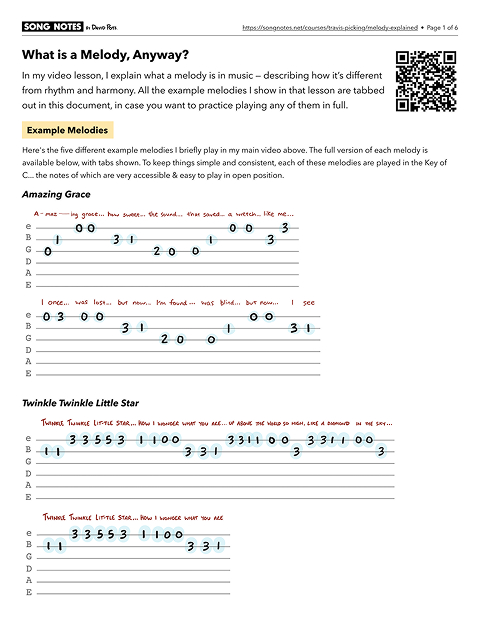
Each of the brief examples I show in this video are available below as full clips, with tabs on screen. Don’t miss the PDF guide for this lesson, where each of the tabbed melodies are presented in a print-friendly format as well.
In the upcoming lessons, we’ll dive into various wasy melody interplays with Travis-style fingerpicking… but I wanted to start with this broad overview of things, should this concept be new to you.
Here’s the five different example melodies I briefly play in my main video above. The full version of each melody is available below, with tabs on screen.
To keep things simple and consistent, each of these melodies are played in the Key of C… the notes of which are very accessible & easy to play in open position. In the lessons that follow, I’ll explain more about melody & musical key, and teach you how to play any melody in any musical key.
In the final few minutes of my main video above, I take the Amazing Grace melody and show several different ways to play it as a lone guitarist. In each of these, the melody that’s played is the exact same.
What’s different is the “other guitar stuff” I’m doing. Single bass notes, strummed chords, and alternating bass notes (i.e. Travis Picking). I even show an example where I sing the melody instead of playing it on the guitar… which is something that happens quite a bit in Travis Picking especially.
Note, I’m playing Amazing Grace in 4/4 time in these examples (four beats per measure). I note this because typically this song is played in 3/4 time. I’ve made this change because 4/4 time is much more common in Travis-style fingerpicking… which is the focus of this course.
Here’s a few lessons that you might enjoy after watching my tutorial above. A few of these dive into Amazing Grace from different approaches (including 3/4 time Travis Picking and lead guitar). I also want to share my lesson on Melodic Double Stops, which I touch on in my main video above using Sloop John B as the example.
 Premium
 VIP
 Beta Tester