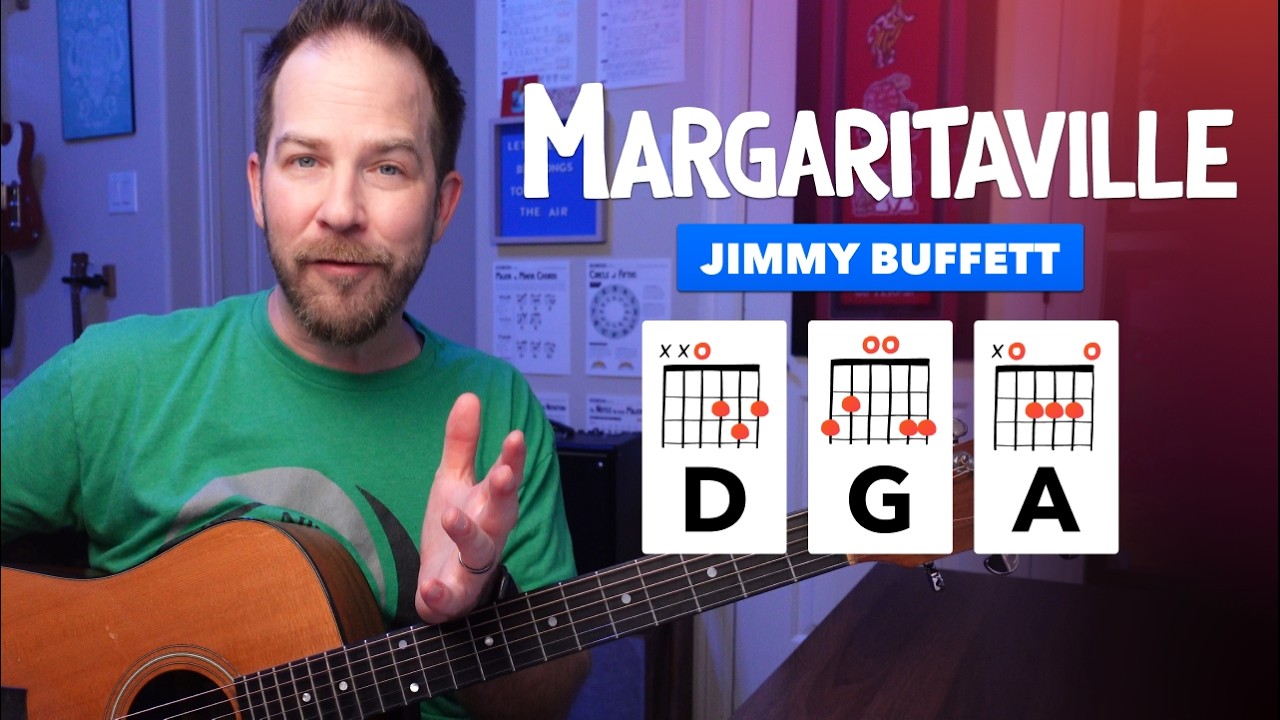
Ever notice how certain chords keep showing up in songs you learn? For example, you may notice how the following clusters of chords are frequently used together:
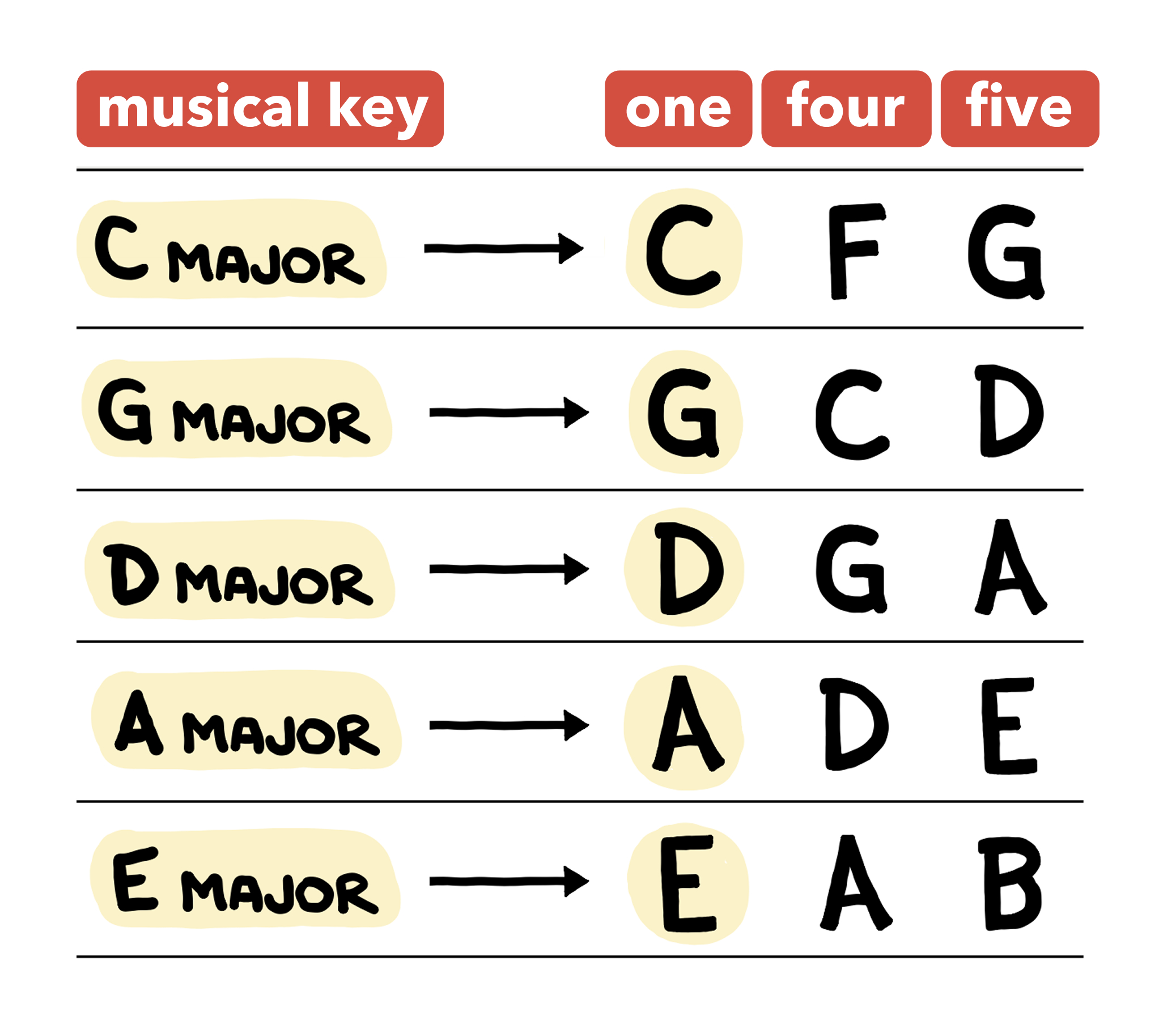
These combinations are not random. They all have something in common: they’re the one, four, and five chords in their respective keys.
In this lesson, I’ll explain where these numbers come from, why these three chords are so useful, and how to find them in the five most common guitar keys. You’ll also learn a handy trick for remembering them using nothing more than your fingers.
In my previous lesson on the Chords in Each Major Key, we learned that all twelve major keys contains seven chords. But… you don’t need to give all seven chords equal attention when getting started. The one, four, and five are especially common… and plenty of songs use only these three chords.
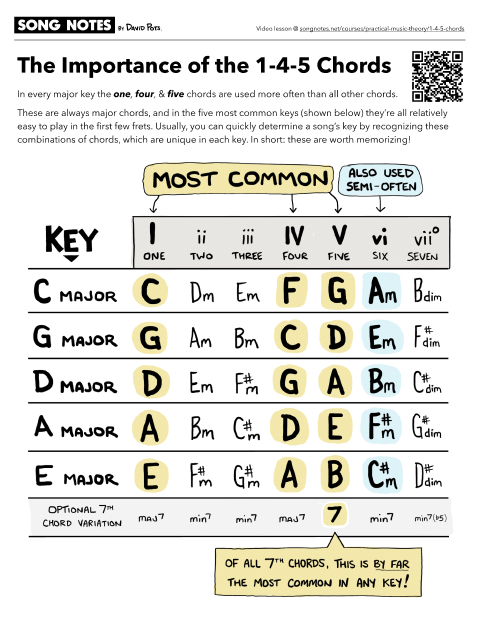
The numbers (1-4-5) refer to the specific notes within the major scale that these chords are built upon. Literally the first note, fourth note, and fifth note. And so, these three major chords in each key can be referred to as the one, four, and five chords.
Here’s what they look like in five most common guitar keys:
As you learn songs, keep an eye out for these groups. Recognizing them can help you quickly identify a song’s key, which is a very helpful skill to have.
Each key has a home chord, which is sometimes called the “tonic”. This is the one chord: C in the key of C, G in the key of G, and so forth. You can think of it as a tonal center within that key.
Try strumming G, C, D… and then returning to G. Listen for that settled feeling when you get back to the G chord. That feeling of arriving home is a useful thing to start recognizing.
The “five” chord in each key, also known as the dominant chord, is noteworthy because of the beautiful tension it creates. Typically, the “five” chord resolves to the “one”, which provides a strong sense of resolution. All the tension is eased and settled.
The five chord is often played as a dominant seventh chord. In the key of G, that means D becomes D7. In the key of C, it means G becomes G7. It’s never required that you use the dominant 7th variation of the five chord, but it always will sound good if you do.
Dominant 7th chords have an extra bit of tension that pulls our ear even harder toward the one chord. Try playing G - C - D - D7 and then resolve back home to G. Notice the “good” tension that’s created by the D and D7 chords, which is resolved and stabilized by G.
Here’s songs I’ve taught that are played entirely with the 1-4-5 chords. These are all grouped by musical key.
An incredibly common choice songwriters make is using 1-4-5 chords and changing keys midway through a song. This can mix things up a bit, in a good way — while still keeping thingis relatively simple from a chord standpoint.
These two start with Key of G (G-C-D), then move up a whole step to Key of A (A-D-E) halfway through:
These two start with Key of D (D-G-A), then move up a whole step to Key of E (E-A-B7) halfway through. You can think of B7 and B as the same chord, in this case. B7 has one additional note, but it’s based on the B-major chord. It’s also easier to play than B… which is why it’s used in so many country & folk songs.

This one has multiple key changes! Key of E (E-A-B7), then Key of A (A-D-E), then Key of D (D-G-A)… and then it works backwards to end where it began, in the Key of E. This, combined with the same relative walking bass line used in each key, makes for quite a fun song to learn.
Likewise, this one starts in Key of E but then moves up to the keys of F, F#, and G. All while using the 1-4-5 chords in each key.
 Premium
 VIP
VIP Beta Tester